The American Outlaw: Two Histories, One Spirit
From its inception, America has produced inventors, industrial titans, statesmen… and outlaws. Not always criminals, though some certainly were, but men who lived outside polite society’s expectations when those expectations stopped making sense. When the Civil War ended in 1865, hundreds of thousands of hardened young men came home trained for violence and survival, only to discover a country that suddenly had little use for either skill. Opportunity was scarce, the frontier was wide, and in many territories the law existed mostly on paper if it existed at all. The American frontier produced a particular kind of man, one whose reputation carried more weight than credentials, whose loyalty was measured in action, and whose handshake was a bond that couldn’t be broken.
From the 1860s and 1890s, outlaw gangs became part of the western landscape. Some were little more than criminals. Others saw themselves as rebels pushing back against land barons, banks, railroads, and distant power structures that seemed to operate above the law. Their reality was more complicated than dime novels or Hollywood ever cared to admit. Many of these men were former soldiers, scouts, ranch hands, and horsemen who understood terrain, strategy, and survival better than the bureaucrats writing laws three states away. Some were reckless. Some were ruthless. And some were surprisingly intelligent operators who understood power, reputation, and human nature better than the sheriffs’ posses chasing them. The wild frontier succumbed to civilization, and the line between lawman and outlaw was blurred more than people today might have imagined. Railroads stitched the territories together. Telegraph lines shrank distances. Territories became states. By the 1890s, the classic horseback outlaw was fading into legend as law enforcement and modern government finally caught up with the frontier. The Wild West, as Americans imagined it, was closing. But the outlaw didn’t disappear; he simply traded horses for machines.
The Second Frontier: History Do-over
It is said that history repeats itself, and roughly a century later, the Industrial Revolution created another kind of American frontier.
Not one of cattle trails and prairie grass, but one of asphalt highways, gasoline engines, and long stretches of open road that disappear into the horizon.
Different century. Different Landscape. Different modes of transportation.
After the Second World War, and later Vietnam, another generation of young men returned home from war as battle-hardened warriors to a society they didn’t recognize, and did not recognize them. It felt smaller, quieter, and strangely disconnected from the horrors of war they wanted to forget. Like many Civil War veterans before them, some struggled to find their place in a rapidly changing America. Some were called to go West. Some lost their way. Others drifted and found their tribe. Not on the open range of the 1860s, but on asphalt and iron steeds with two wheels.
It begins in 1947 with a no-holds-barred club that called themselves the “Boozefighters,” along with the “Galloping Gooses” and a few unforgotten clubs that inspired the movie “ The Wild One. ” Then the old-school outlaw biker era began. Popularized in the 1960s, it ran through the early 1990s, creating a subculture where loyalty, reputation, and independence carried far more weight than public approval. Motorcycle clubs were formed by rugged and fearless men who lived outside the boundaries of polite society. Much like the frontier outlaws before them, they developed their own codes and lived largely indifferent to the approval of mainstream culture, respecting the space and lifestyle of others… until they disrespected theirs. They varnished their words with humor, grit, and a little sarcasm, which made them colorful characters with personalities that were either infectious or intimidating, depending on which side of the conversation you were standing on.
Their code included a practical truth that polite society tends to forget: You don’t blurt out reckless opinions, half-truths, or cheap insults without consequences. In the world of the outlaw, the warning was simple: “When in doubt, knock ’em out.” It was a blunt reminder that words were measured and actions carried weight. To “mis-speak” could be corrected with a black eye and a fat lip, or, in the case of a more serious offense, unforgettable consequences quickly separated the men from the boys. A man learned that speaking without thought could cost him something harder to replace than a few teeth… the trust and respect he had worked to earn.
Brotherhoods were built on that loyalty, respect, and reputation. Over time, a few clubs rose above the rest and took on the same kind of outlaw mystique that surrounded the James Gang, Cole Younger, and other infamous names of the Old West. Like those outlaws, that reputation wasn’t simply claimed; it was earned. The clubs that earned it came to wear the “1%er” patch as a defiant badge of honor, a modern-day echo of the old Western outlaw.
And while it may seem strange or even contradictory to those looking in from the outside, the ol’ school 1%ers lived by their own set of morals and values. It wasn’t society’s code, nor did they pretend it was. It was theirs, and like many of the ol’ school 1%ers who lived by it, much of that code has faded away or been forgotten altogether. What remained was a stubborn refusal to live inside someone else’s definition of order and freedom. The frontier outlaw of the 20th century had traded dusty trails for asphalt highways and horses for motorcycles, but the instinct for independence remained. When conformity became fashionable, there were still men who would rather live outside the barbed-wire fence than comfortably confined inside it. None of this is meant to suggest that outlaws were strangers to criminal activity. They weren’t. Nor does it ignore the fact that there were, and still are, career criminals who wear club colors. But criminal activity alone doesn’t explain the distinction I’m making.
There’s a difference between an outlaw and a criminal.
An outlaw may live outside society’s expectations and refuse to be governed by rules he doesn’t respect, but that doesn’t mean he lives without rules. Respect him, and chances are he’ll return it. Cross the line, and he’ll deal with it according to his own code. A criminal is something different. He borrows the outlaw mystique because it gives him cover. He wears the image, talks the talk, and uses the reputation of the outlaw to disguise what he really is, a predator whose loyalty lasts only as long as it serves him.
The ol’ school outlaw might break society’s rules, but he still had rules of his own.
The outlaw earned the mystique. The criminal hides behind it.
But the outlaw spirit was never confined to horseback or motorcycles. Strip away the leather, the guns, the horses, and the Hollywood mythology, and something older remains, the willingness to stand apart when going along means surrendering what you believe.
The Misunderstood Outlaw
Society has always had a complicated relationship with outlaws. Sometimes the label is deserved. Other times, it’s simply the easiest way to dismiss someone who refuses to comply with mediocrity and reluctantly accepts the status quo.
They are the dissenters.
The nonconformists.
The creatives.
The independent thinkers.
The Outlawed.
Men and women who ask uncomfortable questions and refuse to pretend that obvious problems don’t exist. But their independent streak is deeply American. It’s the same spirit that produced a group of colonial rebels and a ragtag army of farmers, blacksmiths, schoolteachers, and clergy who dared to challenge the most powerful empire on earth. They declared that legitimate authority did not come from kings, but from God, and that government derived its authority from the consent of the governed, and gave the world three words that changed history:
We the People.
Those words didn’t come from timid men worried about their public image. They came from men who understood that the cost of demanding the rights of free men would label them outlaws.
Liberty and the Courage to Stand Apart
Only God-given liberty allows a man to live according to his nature and pursue his God-given rights. A man who lives by his own labor, not at the expense of others, can be trusted to govern himself. He is free to think, to speak, to build, to create, to form partnerships, and to pursue opportunity without coercion. But liberty requires something many people find uncomfortable. Something inalienable.
Responsibility.
Response + Ability = Responsibility. The ability to respond when the moment demands it.
And responsibility requires courage. It is what separates those who desire freedom from those unwilling to fight for it. Because as freedom expands, someone somewhere eventually claims that freedom itself is the problem, and that liberty should be managed by those who believe themselves qualified to interpret how it applies to everyone else.
History shows a predictable pattern, and when authority drifts beyond its proper limits, people who value liberty eventually push back.
But almost always at personal cost.
Sometimes loudly.
Sometimes quietly.
Enter The Outlawed Am3rican
The outlaws of the Old West continue to resonate today, and the people willing to stand outside the barbed fence are often the ones who remind the rest of society why the fence exists in the first place… and who built it. They have taught us about human nature, our desires for freedom, rebellion, and sometimes, power. They remind us of the rugged individualism that characterized this era and how such themes persist in modern narratives, proving that the spirit of the outlaw forever lives on. You can still find them today if you know where to look. In the misfits. The nonconformists.
The few independent minds who refuse to live a life of mediocrity, and care enough about truth to risk being unpopular. Men and women who still believe that virtue, faith, responsibility, and liberty are gifts from God that must be protected.
Call them stubborn.
Call them old-fashioned.
Call them outlaws if you want.
They’ve been called worse.
Because “In times of tyranny and injustice, when the law oppresses the people and the nation is in distress… The Outlaw takes his place in history”.
POSTSCRIPT:
King Solomon reminds us in Ecclesiastes, and like many things in American culture, the era of the true outlaw biker has had its season.
The brotherhood of independent spirits and defiance against the status quo was gradually replaced by an organizational structure that the original old-school riders would have rejected.
Power struggles and lax vetting practices crept in, and the code that once insulated the brotherhood took on a corporate identity, becoming the very thing the original outlaws rebelled against.
The mystique of the outlaw biker may have faded, but their spirit didn’t. It abides in the few originals who are still “above ground.” A little reserved, quietly living out the code most people would never notice… unless confronted with a disrespectful disposition.
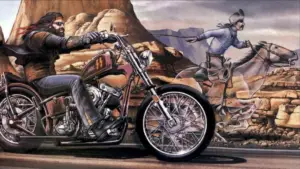
David Mann became a household name in the Outlaw Biker World painting pictures depicting their lifestyle. This one hits the mark comparing the old west outlaws with modern day outlaws.
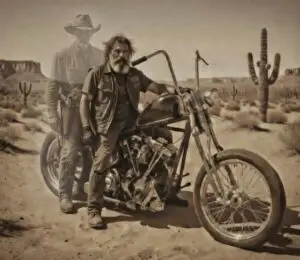
Another image of the past and present outlaws.
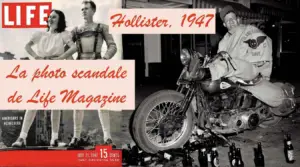
This is the issue of LIFE magazine that broke the story and sensationalized the annual Hollister California motorcycle rally with this photograph.
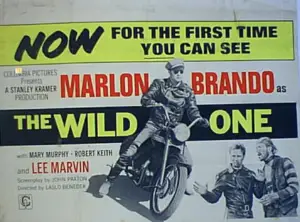
Marlon Brandonreceived top billing for the “Wild One”, but the real wild one recognized by the OGs was played by Lee Marvin.
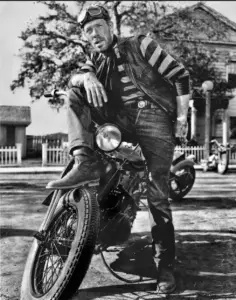
Chino, the Lee Marvin’s character was based on the life of “Wino Willie Forkner” , the real original ‘Wild One” in what has become a classic movie of rebellion and the Biker lifestyle.
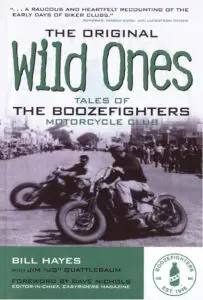
What was the reality behind the myth of the “Wild Ones?” Members of the Boozefighters, and club historian Jim “JQ” Quattlebaum give a firsthand account of what happened in Hollister, and the formation of the Boozefighters. where the seed of the outlaw biker culture was planted.
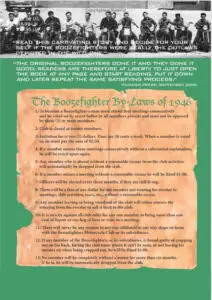
By-Laws of the Boozefighters, who today, believe in peaceful coexistence with other clubs, don’t push religion but have a national chaplin, and are comfortable with who they are…and who they were.
Outlaws!
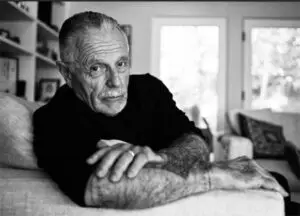
George Gus Christie Jr. is an American author and former outlaw biker best known as the longest-serving president of the Ventura, California chapter of the Hells Angels. A national spokesman and public face of the Angels, he balanced diplomacy, local celebrity, and notoriety through biker wars, legal battles, and community outreach, later chronicling his life in the memoir Exile on Front Street, and Crossing the Rubicon.
A 6 pt series on then Hells Angels narrated by George Christie.
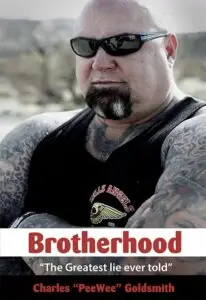
This is not just his story but a piece of history that brings to light the “Brotherhood”, and his life and times as a member of the Hells Angels Motorcycle Club.